Egypt’s First Pterosaur Fossil Adds Wings to the World of Spinoaurus
A 98-million-year-old wing bone from the Bahariya Oasis reveals a four-meter-wingspan flying reptile in one of Africa’s most famous Cretaceous ecosystems
By Hany Zaied
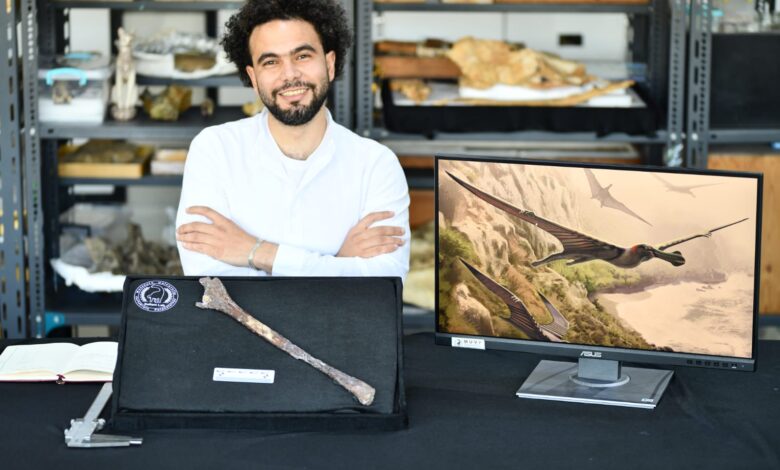
A single wing bone from Egypt’s Western Desert has added a new animal to one of Africa’s best-known fossil worlds. For the first time, researchers have confirmed that pterosaurs, the flying reptiles of the dinosaur age, lived in the Bahariya Oasis, the same Cretaceous-aged ecosystem known for Spinosaurus and Paralititan.
The discovery is described in a study published in Acta Palaeontologica Polonica. The fossil was recovered from the lower Cenomanian Bahariya Formation, a rock unit dating to roughly 95 million years ago, and represents the first confirmed pterosaur fossil from Egypt. Pterosaurs were not dinosaurs, although they lived alongside them. They were the first vertebrates to evolve powered flight, using wings formed by a membrane of skin and muscle supported by an extremely elongated fourth finger.
The Egyptian fossil preserves part of that structure
The Egyptian fossil preserves part of that structure: the first phalanx of the wing finger, one of the main bones supporting the outer part of the wing. Although it is not complete enough to name a new species, its anatomy identifies it as a member of the Ornithocheiriformes, a group of mostly long-winged Cretaceous pterosaurs. Pterosaurs ranged from very small forms with wingspans of about 25 cm to giants with wingspans of around 10–11 m. With an estimated wingspan of about 4 m, the Bahariya pterosaur was not one of the giants, but it was about 16 times broader in wingspan than the smallest known forms and far larger than any living eagle.
“This fossil changes how we picture the Bahariya ecosystem,” said Belal Salem, lead author of the study, a researcher at the Mansoura University Vertebrate Paleontology Center, a PhD candidate at Ohio University, and an Assistant Lecturer at Benha University. “For more than a century, Bahariya has been known for animals that lived on land and in water, from giant dinosaurs to fishes and crocodyliforms. Now we can add the missing third dimension: the pterosaurs in the sky.”
The discovery helps fill a major geographic gap
“Although consisting of only a single wing bone, the anatomy of pterosaurs is so, so unique that we can confidently identify this fossil as belonging to one of the major subdivisions of this group of flighted reptiles,” noted co-author Patrick O’Connor, Director of Earth and Space Sciences at the Denver Museum of Nature & Science. O’Connor added, “Most Cretaceous pterosaurs exhibit evidence of extensive skeletal pneumaticity, air-filled bones like what we see in modern birds, which is one of the reasons that their lightly built skeletons are so rarely preserved in the fossil record.”
The discovery helps fill a major geographic gap. Pterosaurs are known from several Cretaceous localities across northern Africa and Arabia and the southern margin of the ancient Tethys Sea, including Morocco, Tunisia, Lebanon, and Jordan. Egypt lies between these regions, but until now no confirmed pterosaur fossil had been described from the country.
The Bahariya Oasis
“Around a hundred years ago, the Bahariya Oasis provided humanity’s first glimpses of Spinosaurus and other extraordinary dinosaurs that lived in North Africa toward the end of the Cretaceous,” said co-author Dr. Matthew Lamanna, Mary R. Dawson Curator of Vertebrate Paleontology at Carnegie Museum of Natural History.
Lamanna added: “Tragically, though, these species went extinct a second time, when their bones were destroyed during the war. It took more than a half-century, but beginning in the 2000s, we paleontologists began to restore Bahariya’s fossil legacy. Today, research there is thriving. Projects like this are core to Carnegie Museum of Natural History’s mission to advance knowledge of the natural world. I’m honored to have worked alongside the Mansoura University Vertebrate Paleontology Center team on this significant discovery.”
Egypt reveals animals never before documented
The pterosaur fossil was collected during a 2018 expedition by the Mansoura University Vertebrate Paleontology Center team from deposits near Gebel El Dist in the northern part of the Bahariya Oasis. These deposits represent an ancient fluvial-floodplain environment shaped by rivers and a nearby seacoast, with vegetation, fishes, crocodyliforms, turtles, and dinosaurs. The bone was preserved in three dimensions, providing rare evidence of the wing skeleton of a pterosaur from Egypt.
“Although the Bahariya Oasis has been known to paleontologists for more than a century, recent Egyptian-led fieldwork continues to reveal animals never before documented from this classic fossil region,” said Hesham Sallam, professor of vertebrate paleontology at Mansoura University and senior author of the study. “From the first abelisaurid dinosaur from the Bahariya Formation to the first pterosaur from Egypt, these discoveries show that Bahariya still has much more to tell.” Together, the findings provide the first direct evidence of pterosaurs from Egypt and add a new aerial component to one of Africa’s most celebrated Cretaceous ecosystems.