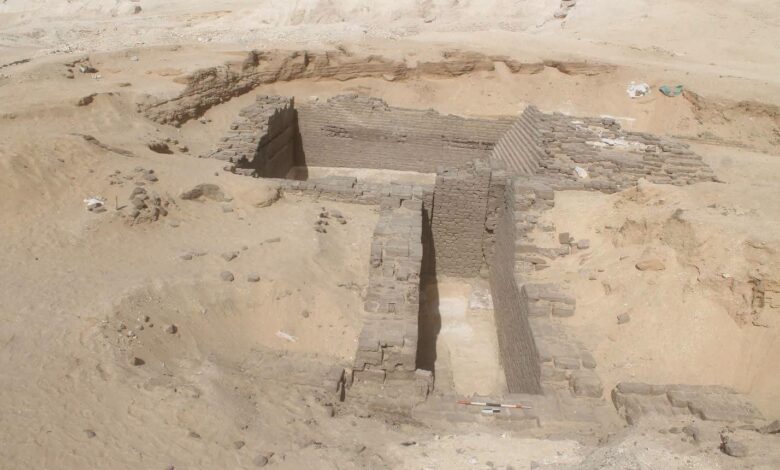
A major archaeological discovery has been unearthed in the Gabal El-Teir area of Minya Governorate.
An Egyptian archaeological mission, affiliated with the Supreme Council of Antiquities, discovered two rare tombs dating back to the Early Dynastic Period, along with several burials from the Predynastic and Late Periods.
The discovery provides significant evidence for tracing the evolution of funerary architecture in Ancient Egypt.
Experts noted that the design of the tombs, which feature walls increasing in thickness from base to top, bears a striking resemblance to the famous tomb of King Den in Abydos, suggesting an early engineering phase that may have influenced the later development of the step pyramid.
Dr. Sami Dardiry, head of the mission, explained that the site also yielded Predynastic burials in a crouching position wrapped in decaying plant mats, accompanied by black-rimmed pottery dating back to the Naqada II and III periods.
Furthermore, individual and collective human burials, likely from the Late Period, were found inside decayed wooden coffins, confirming the site’s long-standing importance as a necropolis throughout Egyptian history.